
teamLab is an international art collective. Their digital art museums are immersive experiences that explore the intersection of art and technology. Originally formed by a group of artists in Tokyo in 2001, the collective now has dozens of museums, exhibitions, and public art displays both in Japan and around the world.
Perhaps two of the most famous are teamLab Planets and teamLab Borderless in Tokyo. Planets is most well known for its water exhibit where visitors take off their shoes and walk through shallow water with digital koi swimming all around them. Borderless is a museum that takes its name quite literally – the digital artwork flows from one room to the next without borders.
We opted to go to Borderless, both because of its location (very close to our hotel!) and because my husband had been to Planets before. Tickets go on sale via the teamLabs website on the first day of the month two months in advance (for example, March tickets go on sale January 1). Although tickets do sell out, this is not a situation where tickets will sell out within minutes (or even days) of the window opening. Typically buying 2-3 weeks in advance is safe.
Tickets are timed entry, with slots available every 30 minutes. Although you will have an entry time, you can stay as long as you want. We opted for a 9:30 am slot – early enough to not be too crowded yet but not too early that my teenagers complained.
TeamLab Borderless is in the Azabudai Hills neighborhood of Tokyo on the basement floor of the Garden Plaza B building. We had an easy walk from our hotel in Roppongi but you can also take the train to nearby Kamiyacho Station.
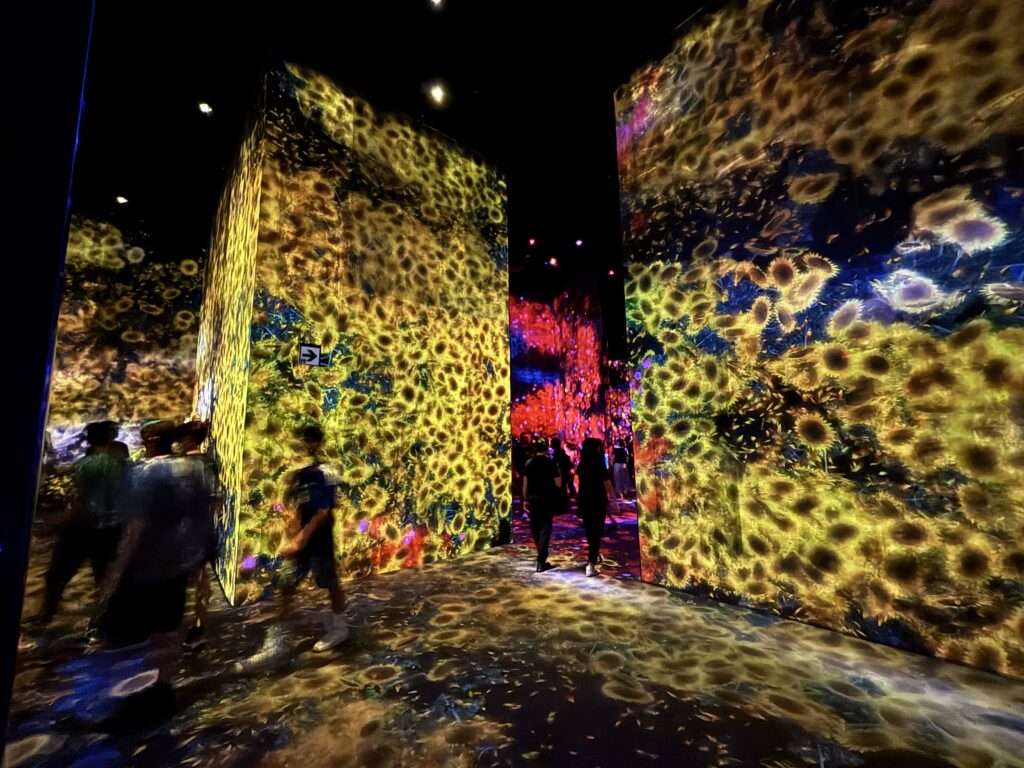
Its location in the basement is functional – there are no windows in the museum and the only lighting is from the digital art itself. It is dark and sometimes disorienting as you wind your way through the different rooms. The first room we entered reminded me of the Immersive Van Gogh exhibit we went to in Charlotte a few years ago. Sunflowers and other floral projections bloomed and grew on the walls.
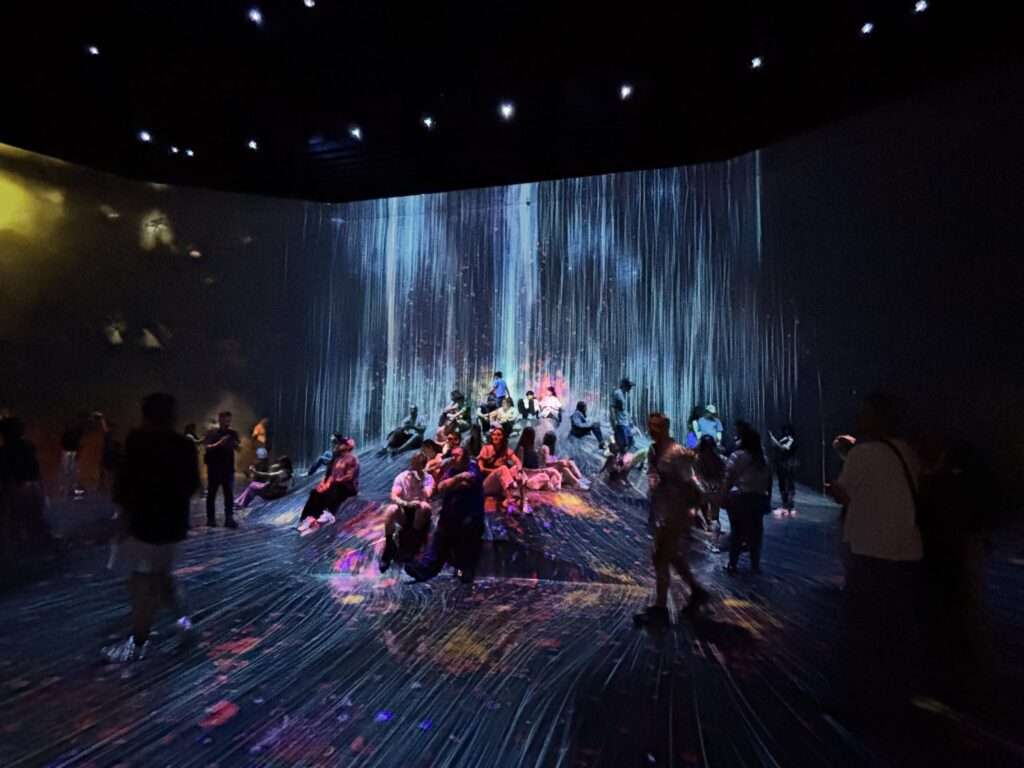
We entered one of the main rooms, the not-so-succintly-named “Universe of Water Particles on a Rock where People Gather”. This was a large open room with a (you guessed it) rock in the center along the back wall where people could (you guessed it again) gather to watch the moving artwork on the walls. Touching the wall or leaning against it resulted in the art changing, literally reacting to your presence. The wall behind the rock had water projections flowing down it. Touching the wall changed the flow of the water, an amazing interactive effect. The other walls had images and Japanese characters floating by that would disappear if you touched them.
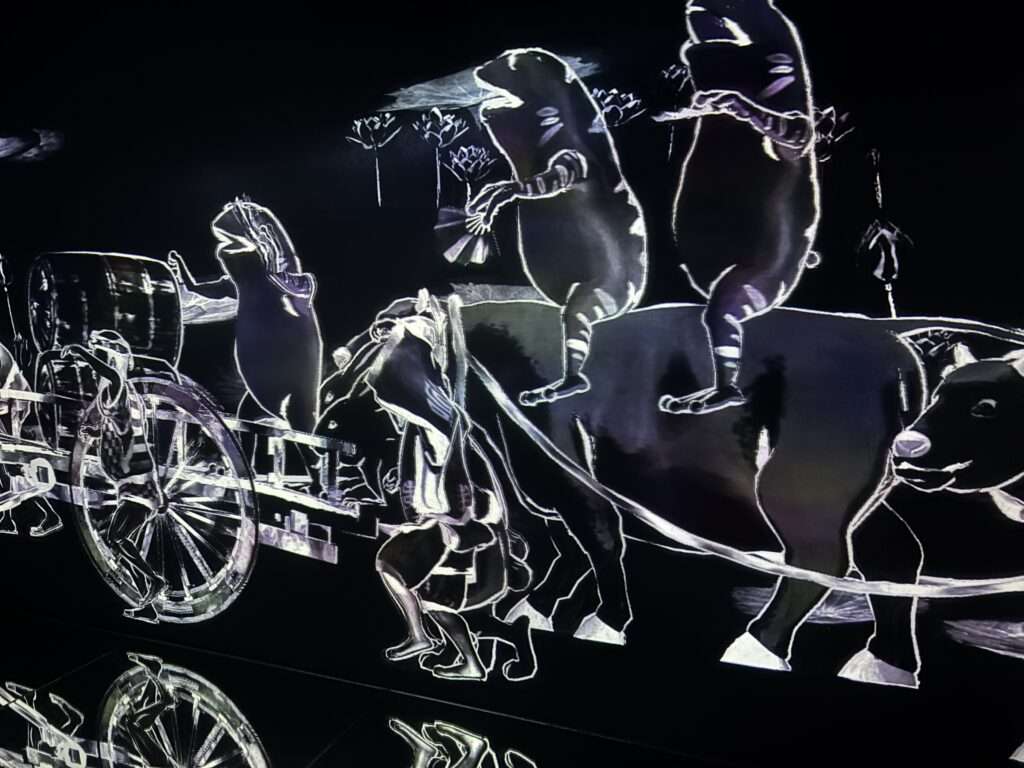
From there we headed out into a hallway, which surprisingly ended up being one of my favorite parts of the museum. The walls in the hallway were completely black and there was a slow-moving parade of creatures that walked past, gently moving to the music. It was incredible. Frogs rode oxen, rabbits pushed wagons, and people danced to the music. Other sections had flowers blowing in the breeze in time with the music. The scenes were constantly changing and the music was so relaxing. I probably could have stood in the hallway the entire time and been happy.
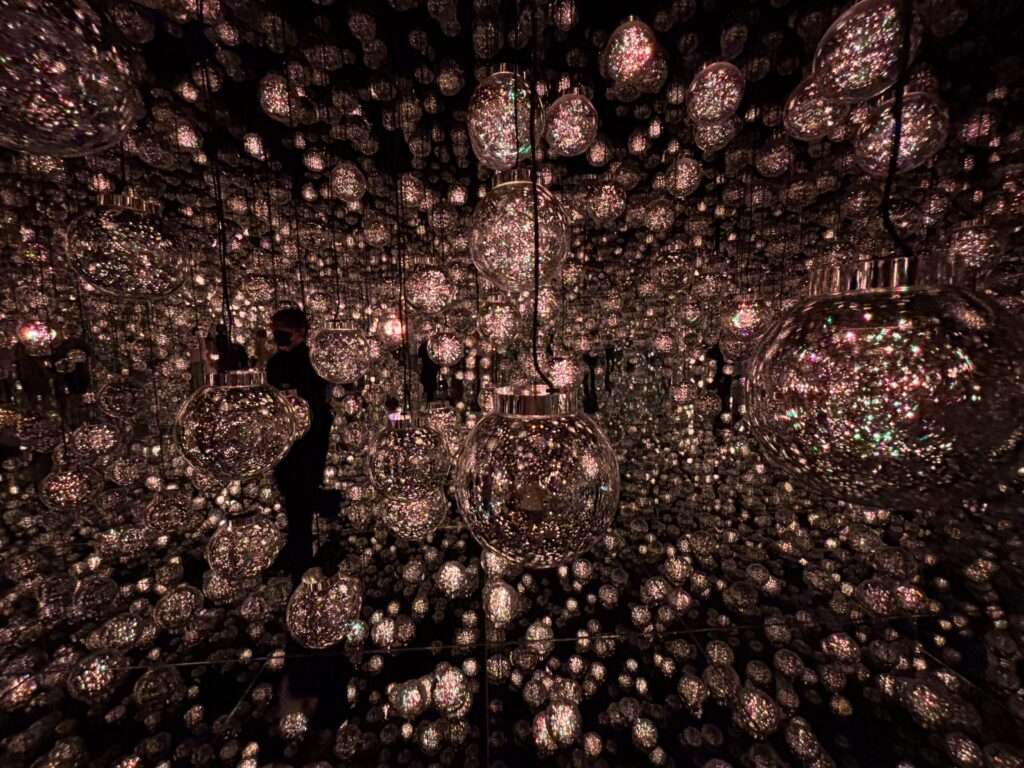
As great as the hallway was, we did have a few favorite rooms too. Probably at the top of all of our lists was the bubble room, more formally known as “Bubble Universe: Spherical Crystallized Light, Wobbling Light, and Environmental Light – One Stroke”. Hundreds of glass spheres hung from the ceiling, each one containing a light that reacted to the movement of guests and to the light of neighboring spheres. Although it wasn’t super crowded while we were in there, I think the effect of the light branching out and spreading across the room is more pronounced when the room is mostly empty. Still, the glass balls and lights were an amazing effect and we all loved this room.
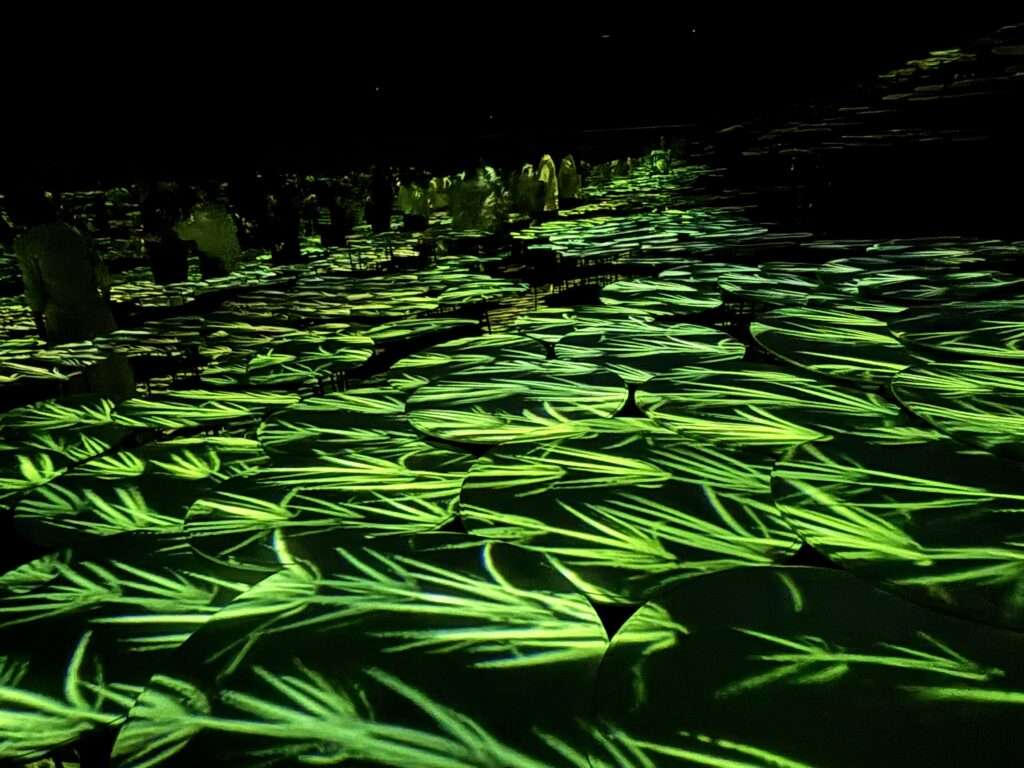
Another really cool room was “Seasons in the Lily Pad Pond”. This room featured hundreds of flat, black circles (“lily pads”) with green leaves projected onto them that moved when you walked by as if blowing in a breeze that you created. There were also fish, flowers and birds that passed over the lily pads, representing the changing seasons.
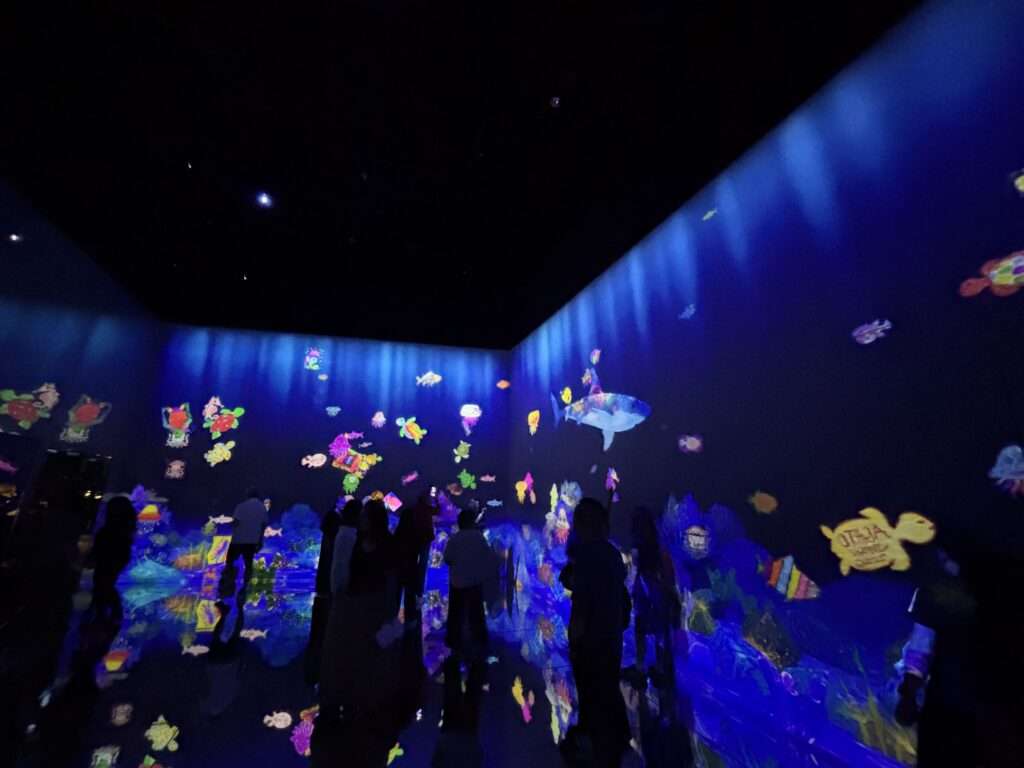
And finally, “Sketch Ocean” was clearly a kid-favorite… even 18 year old kids! The walls of this room were designed to look like an underwater ocean scene and visitors’ drawings were the inhabitants. Guests could wait on line to go into a separate room and color in templates of various sea creatures. Those pictures were then scanned, digitized, and projected onto the walls. As if it wasn’t cool enough that you could watch your fish swim across the sea, you could also interact with it. Touching it made it change directions or swim away, and opening the digital container of food that periodically dropped into the tank attracted all the fish to that spot. And keeping with the borderless theme, the fish all eventually swam out of the room and down the hall.
One of the key features of teamLab Borderless is that it is “a museum without a map”. And not only is there no map, but there is no natural flow. Rooms are tucked away down dark hidden hallways, making it easy to miss exhibits. All the hallways are dark and look the same, making it difficult to know where you are and if you’ve been there before. It is just not an easily navigated place. For a lot of people the “no map” feature is amazing – it instills a sense of wonder and exploration. For others (like me), it is stressful. I always felt lost, wasn’t sure how to get out, and still don’t know if I saw all the exhibits.
Whether you wish you had a map or not, I think most people will really enjoy teamLab Borderless. It is undeniably unique and the interactive features are so impressive. For me personally, I’m really glad I went but don’t know that I would necessarily seek out a visit to Planets or another teamLab location. I think the wow-factor is there for the first visit and after that it is probably somewhat repetitive.
